
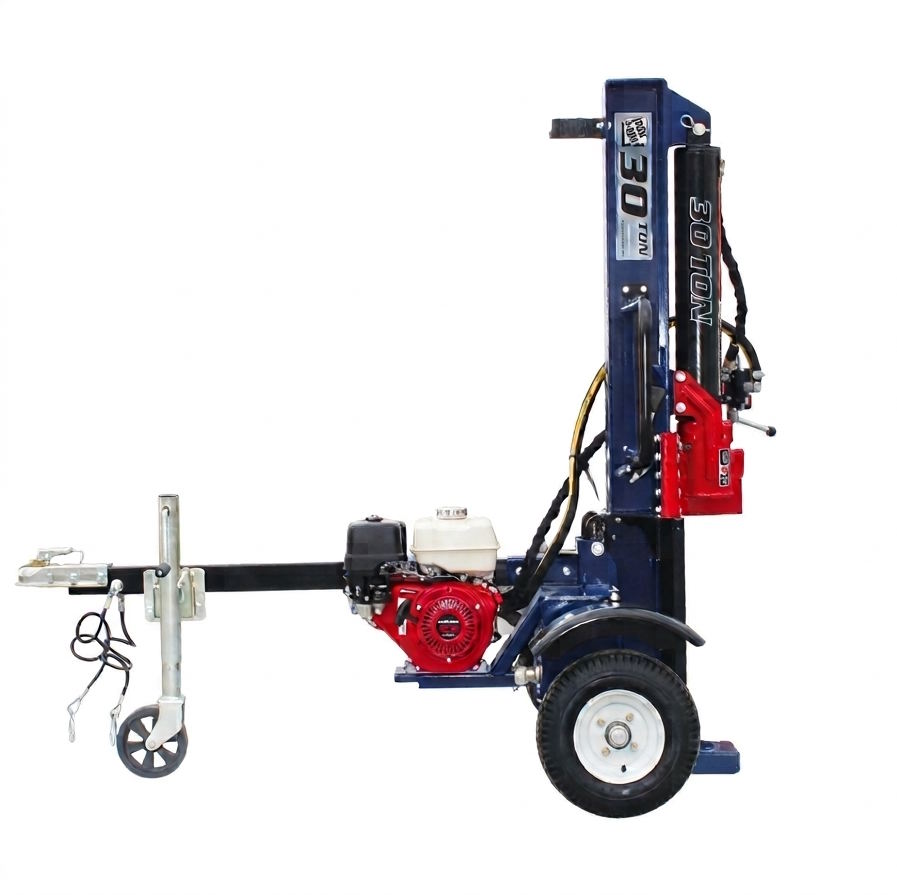
Renting a log splitter in Vermont runs through a local rental counter rather than a fixed online price, so call ahead for the daily rate. Johnson Hardware & Rental rents 20-ton and 30-ton gas-powered Iron and Oak splitters. Most firewood needs 6 to 12 months to season before it burns clean.
How much does it cost to rent a log splitter?
Log splitter rental rates vary by size, rental length, and whether you need delivery, so there is no single price that holds true everywhere. [Call for current daily and weekly rental rate.] Johnson Hardware & Rental rents two sizes, a 20 ton and a 30 ton Iron and Oak splitter, so the real cost question is which size fits the wood you are actually splitting, not just the rate itself.
A bigger splitter costs more to rent but saves time on large or knotty rounds. If most of your wood is already a manageable diameter, the smaller 20-ton unit usually gets the job done for less.
Gas or electric?
Johnson Hardware & Rental's rental fleet is gas-powered. Both the 20-ton and 30-ton Iron and Oak splitters are towable units built for a full day of splitting, not light-duty electric models made for a few logs at a time.
Electric log splitters exist and work fine for small amounts of firewood at a slower pace. If you are processing a cord or more at once, a gas-powered rental splitter with real tonnage behind it is the faster, more practical choice. If you are clearing fallen trees before you split them, Johnson Hardware & Rental also sells Milwaukee's M18 FUEL battery chainsaws in store.
How do I use a log splitter safely?
A log splitter is simple to run once you know the sequence, and most injuries come from rushing the same two steps: loading the log and clearing the ram.
-
Set the splitter on level, stable ground before you start, and chock the wheels if it is still hitched.
-
Keep both hands clear of the wedge and the ram's path. Never try to help a log through by hand once the ram is moving.
-
Load one log at a time, centered on the beam, and keep your footing clear of where a split piece could kick out.
-
Watch for knots and crotches. They can bind or deflect the wedge instead of splitting clean, so go slow on anything that looks irregular.
-
Keep kids and bystanders back a few feet during operation. The ram and the splitting force deserve the same respect as any other heavy equipment.
-
Shut off the engine before walking away, even for a minute, and before clearing a jam.
How long does firewood need to season?
Softwoods like pine, spruce, and fir need at least 6 months of seasoning. Hardwoods like oak, maple, and ash need at least 12 months, and sometimes longer for dense species split in large rounds, according to Vermont's Department of Environmental Conservation.
-
Softwood, pine, spruce, fir: at least 6 months
-
Hardwood, maple, ash, birch: at least 12 months
-
Oak: 12 months or more, it is one of the slowest common woods to dry
-
Wood split and stacked right after cutting dries faster than wood left in rounds
Splitting wood sooner rather than later speeds up seasoning significantly, since a split face exposes far more surface area to air than a round log ever does. That is the practical case for renting a splitter the same week you cut or buy your wood, not months later.
How do I know firewood is dry?
The most reliable way is a moisture meter, checking a freshly split face rather than the weathered outside of a log. Wood ready to burn should read 20 percent moisture or less, per EPA's Burn Wise program.
-
Noticeably lighter than when it was green
-
Cracked, checked ends
-
Hollow sound when two pieces are knocked together
-
Bark that is loose or falling off
-
Gray, faded color instead of the fresh-cut look
Frequently asked questions
Is a vertical or horizontal log splitter better for most jobs? Horizontal splitters are easier to load for most homeowner-sized rounds and are what Johnson Hardware & Rental rents. Vertical splitters suit very large, heavy rounds you cannot comfortably lift onto a horizontal beam.
Can you split green, freshly cut wood with a rental splitter? Yes. Splitting green wood is easier on the splitter and on you, since dried wood is harder and more likely to bind or crack unevenly.
How much firewood is in a cord, and how long does it last? A full cord is a stack 4 feet by 4 feet by 8 feet. How long it lasts depends on your stove, climate, and how much you burn, but a cord typically covers several weeks of regular wood heat in a Vermont winter.
Do you need a special license to operate a rental log splitter? No license is required to operate a towable log splitter, though you need a vehicle rated to tow it if you are picking it up yourself.
Can a log splitter handle large rounds or knotty wood? A 30-ton splitter handles large, knotty rounds better than a 20-ton unit, though an extremely gnarled crotch or root ball can still bind any splitter. When in doubt, size up.
Is there a faster way to season firewood than waiting out the full timeline? Splitting wood smaller, stacking it in a single row instead of a pile, and placing the stack somewhere it gets full sun and wind all speed up drying, but none of it replaces time entirely.
A note from Johnson Hardware & Rental
We rent both a 20 ton and a 30 ton Iron and Oak log splitter, and we carry splitting mauls, wedges, and moisture meters if you would rather do it by hand or just want to check your own stack before burning. Stop in or call us at (802) 635-7282 for current rental rates and delivery fees.