If you work with your hands for a living, your cordless tool platform is one of the most important decisions you will make. Once you invest in batteries, chargers, and a handful of tools, you are committed to that system for years. That is why the choice between Milwaukee's M18 and M12 platforms matters so much. Both are built with the same commitment to professional-grade performance, but they are designed for different kinds of work.
At Johnson Hardware & Rental in Johnson, VT, we are the largest authorized single-store Milwaukee Tool dealer in New England. Our team includes staff who specialize exclusively in Milwaukee, which means we do more than stock shelves. We help electricians, plumbers, contractors, HVAC techs, and municipal crews figure out exactly which platform and tools match their trade, their workflow, and their budget. This guide breaks down the M18 and M12 systems so you can walk into our store with a clear idea of what you need and walk out with the right tools the same day.
Understanding the Two Platforms
Before getting into the specifics of each system, it helps to understand what separates M12 from M18 at a fundamental level.
The M12 is Milwaukee's 12-volt cordless platform. It was designed from the ground up for compact, lightweight tools that excel in tight spaces, overhead work, and precision tasks. The M12 system powers over 150 different tools, and one battery works across the entire lineup. M12 tools tend to weigh less, cost less, and fit into spaces where larger tools simply cannot go.
The M18 is Milwaukee's 18-volt platform, built for heavy-duty power, longer runtime, and the kind of sustained performance that demanding jobsites require. M18 tools deliver higher torque, faster cutting speeds, and the ability to power through materials that would slow a 12-volt tool down. The M18 ecosystem is even larger than M12, covering everything from drills and impact drivers to chainsaws, table saws, and concrete tools.
Both platforms use Milwaukee's REDLITHIUM battery technology and REDLINK PLUS intelligence system, which protects against overheating, overloading, and over-discharging. Both also feature FUEL models with brushless motors that deliver more power, longer runtime, and extended tool life compared to brushed alternatives. The key difference is that M12 and M18 batteries are not interchangeable. They are two separate ecosystems, and the tools you buy lock you into one platform or the other, unless you decide to run both.
Power and Performance: Where Each Platform Shines
Raw power is the most obvious difference between the two systems. M18 FUEL tools consistently deliver more torque, higher RPMs, and greater cutting capacity than their M12 counterparts. For example, the M18 FUEL impact driver produces around 2,000 inch-pounds of torque, while the M12 FUEL version delivers approximately 1,300 inch-pounds. That is a significant gap when you are driving lag bolts, working with heavy fasteners, or powering through dense material all day.
The M18 FUEL circular saw runs a full-size 7-1/4 inch blade and can handle dimensional lumber, plywood, and sheet goods with the same authority as a corded saw. The M12 FUEL circular saw uses a 5-3/8 inch blade, which is excellent for trim work, finish carpentry, and quick crosscuts, but it is not built for framing or heavy sheet cutting.
That said, the M12 platform punches well above its weight class. M12 FUEL tools use the same brushless motor technology and advanced electronics as M18 FUEL, just in a smaller package. For many tasks, especially in the electrical, plumbing, and HVAC trades, the M12 delivers more than enough power while keeping weight and bulk to a minimum.
The takeaway is straightforward. If your daily work involves high-demand cutting, drilling, and driving through tough materials, M18 is the platform you need. If your work involves more precision tasks, lighter fastening, and tight-space access, M12 handles it with less fatigue and more maneuverability.
Battery Life and Runtime
Battery runtime is where the M18 platform pulls ahead for professionals who need to power through a full shift without constantly swapping batteries.
M18 batteries come in a wide range of capacities. Compact Performance (CP) packs start at 2.0Ah for lighter tools. Extended Capacity (XC) batteries run from 5.0Ah to 8.0Ah for general daily use. And High Demand (HD) batteries go all the way up to 12.0Ah for the most power-hungry tools on the platform. That variety means you can match your battery to the tool and the task, carrying a lightweight pack for a drill and a high-output pack for a grinder.
M12 batteries range from 1.5Ah to 6.0Ah. For the type of tools the M12 platform powers, these capacities are generally sufficient. An M12 FUEL impact driver equipped with a 2.0Ah battery can drive roughly 220 to 250 screws on a single charge, and stepping up to a 4.0Ah pack nearly doubles that output. For most electricians, HVAC techs, and plumbers, a couple of M12 batteries and a charger will get through a full day without issue.
The real difference shows up on long, demanding jobs. If you are running a high-output tool like a circular saw, reciprocating saw, or grinder for extended periods, the M18 platform's larger batteries provide noticeably more endurance. For intermittent use and lighter tools, M12 batteries perform just fine.
Size, Weight, and Ergonomics
This is where the M12 platform earns its reputation. M12 tools are noticeably smaller and lighter than their M18 equivalents, and that difference adds up over the course of a long workday.
The M12 FUEL impact driver weighs under 2 pounds as a bare tool and measures just over 5 inches in length. That compact size lets it fit between studs, inside junction boxes, under sinks, and into the kind of cramped spaces that are part of daily life for electricians, plumbers, and HVAC technicians. You can carry an M12 tool on your belt or in a pouch all day without it dragging you down.
M18 tools are heavier and bulkier, especially when paired with high-capacity batteries. That extra weight is the tradeoff for more power and longer runtime. For tasks that require sustained force, like driving through multiple layers of material or running a rotary hammer, the added heft actually helps. But for overhead work, repetitive fastening, and all-day carry, M18 tools create more fatigue over time.
Many professionals who have spent years in their trade end up running both platforms specifically because of this tradeoff. The M12 handles the majority of daily tasks with less strain, while the M18 stays in the truck or on the cart for the heavier jobs that require more muscle.
Choosing by Trade: Which Platform Fits Your Work
The best way to choose between M18 and M12 is to think about the specific demands of your trade. Here is how the two platforms tend to break down across common professions.
Electricians
Electricians consistently favor the M12 platform for daily carry. The compact impact driver, screwdriver, wire cutters, LED work lights, and cable cutter all fit the trade perfectly. M12 tools are easier to maneuver in panels, boxes, and above-ceiling spaces. Many electricians keep an M18 hammer drill or hole hog on the truck for roughing in, but reach for M12 for 80 percent or more of their daily work.
Plumbers and HVAC Technicians
Plumbers and HVAC techs often benefit from running both platforms. The M12 is ideal for tight-space repairs like sink installations, pipe cutting, and PEX work. The M18 steps in for larger jobs such as drilling through walls, running large hole saws, or powering a press tool for extended periods. Having both platforms provides the flexibility these trades demand.
General Contractors and Framers
If you are framing walls, building decks, or doing heavy remodeling, M18 FUEL is the primary platform. You need the torque, the cutting capacity, and the battery runtime to power through full days of demanding work. The M18 FUEL circular saw, reciprocating saw, and impact driver are the backbone of most general contractor setups.
Municipal and Utility Crews
Municipal crews in Vermont often need a mix of heavy-duty power tools and compact specialty tools. M18 handles chainsaws, grinders, and high-torque impact wrenches for infrastructure work, while M12 provides convenient options for inspections, lighting, and quick repairs. Johnson Hardware & Rental works directly with municipalities and contractors across Vermont to build out Milwaukee tool inventories that match the specific needs of their crews.
FUEL vs. Non-FUEL: Is the Upgrade Worth It?
Within both the M12 and M18 lineups, Milwaukee offers standard brushed-motor tools and upgraded FUEL models with brushless motors. The FUEL versions cost more upfront, but the performance difference is significant.
FUEL tools deliver more power from the same battery, which means higher torque and faster speeds without draining the pack as quickly. Brushless motors also generate less heat and friction, which extends the life of both the motor and the battery. For professionals who use their tools every day, the durability and efficiency gains from FUEL models pay for themselves over time.
Non-FUEL tools are a solid option for homeowners, weekend DIYers, and anyone who does not need to push their tools to the limit on a daily basis. They still carry Milwaukee's build quality and use the same battery platform, so they are a cost-effective way to get into the system.
At Johnson Hardware & Rental, our Milwaukee specialists can walk you through the differences between specific FUEL and non-FUEL models in person. We keep both tiers in stock, so you can compare them side by side and make the call based on your actual usage.
Running Both Platforms: The Case for a Dual Setup
A growing number of professionals run both M12 and M18 tools, and for good reason. It is not about choosing one over the other. It is about using the right tool for the right task.
A typical dual-platform setup might look like this: an M12 FUEL impact driver and drill on the belt for all-day use, with an M18 FUEL hammer drill, circular saw, and reciprocating saw on the truck for the jobs that need more power. You end up carrying less weight throughout the day while still having full access to heavy-duty capability when the work calls for it.
The cost of running two battery systems is a real consideration, but many tradespeople find that the productivity gains and reduced fatigue offset the extra investment in batteries and chargers. If you are starting from scratch, our team at Johnson Hardware & Rental can help you build a dual-platform kit that covers your trade without buying tools you do not need.
Pricing and Getting the Most Value
M12 tools generally cost less than their M18 equivalents. Bare-tool M12 FUEL models typically start around $99 to $160, while M18 FUEL bare tools range from roughly $129 to $250 depending on the tool category. Combo kits and starter kits offer better value per tool when you are building out a new system.
Milwaukee also runs periodic promotions with deals on combo kits, free batteries with qualifying purchases, and discounted bundles. Johnson Hardware & Rental keeps an updated Milwaukee Promotions page with the latest in-store specials, and our deals are available only while supplies last. Checking in regularly or asking our Milwaukee team about current offers is one of the easiest ways to save on your next purchase.
One thing to keep in mind: buying the cheapest tool that technically fits the job is not always the best value. An underpowered tool that slows you down or wears out prematurely costs more in lost productivity than investing in the right platform from the start. Our specialists help customers think through that calculation every day.
Warranty and Repair: A Benefit Most Buyers Overlook
One of the most overlooked advantages of buying Milwaukee tools from an authorized dealer is access to warranty support and professional repair. Johnson Hardware & Rental is an authorized Milwaukee Tool warranty and repair center, and all repairs are done in-house by our skilled technicians right here in Johnson, VT.
That means when a tool goes down, you do not have to box it up, ship it out, and wait weeks to get it back. You bring it in, our team diagnoses the issue, confirms warranty coverage, and gets it repaired with genuine Milwaukee parts. For professionals who depend on their tools to make a living, that kind of turnaround time matters.
This is a significant advantage over buying from a big-box retailer or online marketplace that cannot offer in-house repair. When you buy from Johnson Hardware & Rental, you are not just getting a tool. You are getting a long-term service relationship with a team that stands behind what they sell.
Why Vermont Pros Buy Their Milwaukee Tools at Johnson Hardware & Rental
There are plenty of places to buy Milwaukee tools, but there is a reason professionals across Vermont and beyond make the trip to Johnson Hardware & Rental. Our Milwaukee Tool department is the largest single-store authorized Milwaukee dealer in New England, with dedicated staff who know the product line inside and out.
When you walk into our store, you are not navigating a locked display case hoping someone in a general hardware vest can answer your question. You are talking to people who work with Milwaukee tools every day, understand the differences between models, and can recommend the right setup for your specific trade and workload.
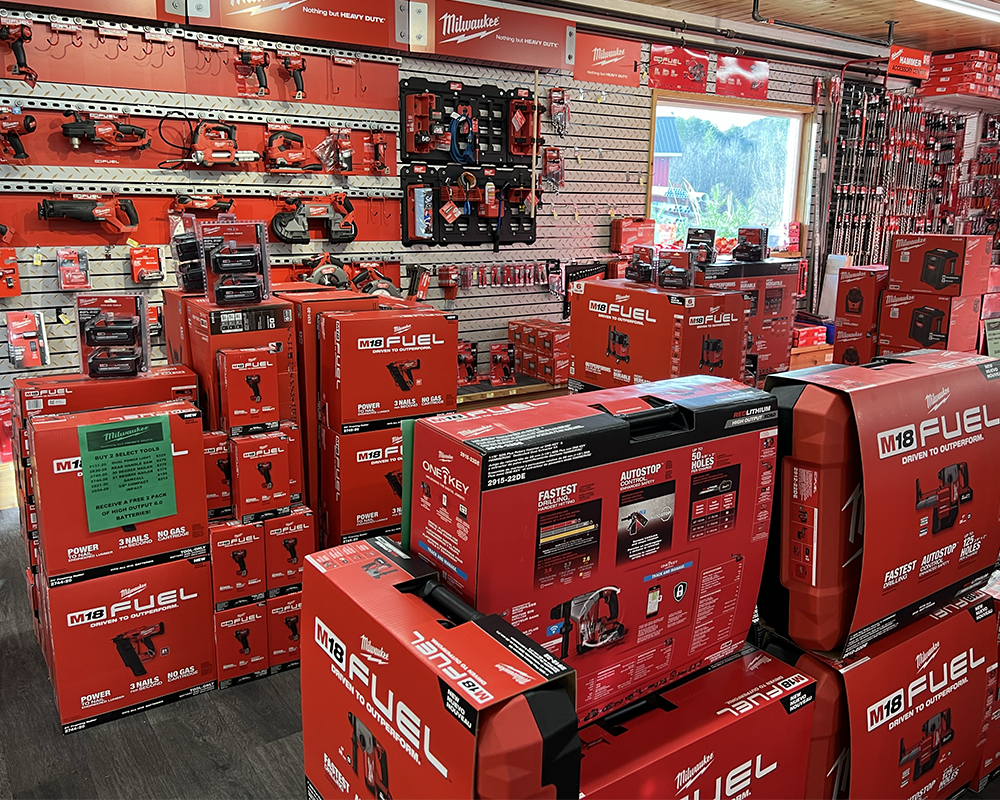
We keep a deep inventory of M12 and M18 FUEL cordless tools, hand tools, batteries, chargers, accessories, and PACKOUT storage systems in stock and ready to go. Most customers walk in and walk out with exactly what they need the same day. And because we are also an authorized warranty repair center, you have a local partner for the life of your tools.
Our store is located at 1442 VT Route 15 in Johnson, VT, just 25 minutes from Stowe, 15 minutes from Smugglers' Notch, and about an hour from Burlington. While you are here, you can also check out our equipment rentals, building supplies, workwear, and everything else our 25,000-square-foot store has to offer.
Find the Right Milwaukee Platform for Your Trade
Choosing between Milwaukee's M18 and M12 platforms comes down to how you work, what your trade demands, and how you want your tools to feel in your hands at the end of a long day. M18 delivers the power and runtime for heavy-duty trades. M12 delivers the compact precision for tight-space work and all-day carry. And for many pros, running both is the smartest move.
Whatever direction you go, the best way to make the decision is to get hands-on with the tools and talk to someone who knows the lineup. Stop by Johnson Hardware & Rental at 1442 VT Route 15 in Johnson, VT, give us a call at 802-635-7282 (ask for Craig at extension 104 for Milwaukee-specific questions), or check out our full Milwaukee selection online. We are open Monday through Friday 7am to 6pm and Saturday 8am to 4pm.